Offshore wind power is electricity from turbines fixed to the seabed or floating in deep water, and the world had 92.5 gigawatts of it at the end of 2025. The US now has more than 1,600 megawatts running, after two large farms off New England reached full operation in October 2026, and three more are due to finish in 2027.
Top offshore wind statistics
- The world had 92.5 gigawatts of offshore wind capacity at the end of 2025, and more than 50 gigawatts is under construction.
- Global additions were 9.3 gigawatts in 2025, with China commissioning 6.6 gigawatts of that.
- Revolution Wind, a 704 megawatt farm with 65 turbines, reached full operation off Rhode Island in the fall of 2026.
- Vineyard Wind 1 off Massachusetts, with 62 turbines, is the largest operational offshore wind farm in the US.
- Coastal Virginia Offshore Wind has 44 of its 176 turbines installed on the way to 2.6 gigawatts.
- Newly built offshore projects averaged a 41% capacity factor in 2023, against 36% for onshore wind.
- The floating Hywind Scotland farm delivered a 54% capacity factor over its first five years.
How a turbine in the ocean makes electricity
A turbine blade is shaped like an airplane wing turned on its side. Wind rushing over its curved face creates lift, and that force spins the rotor, which turns a shaft inside the nacelle and drives a generator. The current runs down the tower and through a subsea cable buried in the seabed until it comes ashore.
In shallow water, 0 to 30 meters deep, turbines usually stand on a gravity base or a single steel pile called a monopile, which is the foundation used most often. At transitional depths of 20 to 80 meters, developers switch to a lattice jacket or a tripod. Beyond that, floating turbines take over, with foundations that work at depths from 40 to 1,000 meters and sit on barges, semi-submersibles or buoys moored to the seabed. Japan is counting on floating turbines to close the gap in its own offshore targets.
The payoff for building this far out is stronger and more consistent winds, which let developers use larger turbines. Machines at sea follow the same path as the land-based turbines that keep growing, and Coastal Virginia’s 176 Siemens Gamesa turbines are among the largest installed in US federal waters.
How much offshore wind power has the world built?
By the stricter count in the table below, the world’s offshore wind fleet grew more than sixfold over the decade.
| Year | World offshore wind capacity in operation (GW) |
|---|---|
| 2016 | 12.8 |
| 2017 | 17.0 |
| 2018 | 22.1 |
| 2019 | 27.3 |
| 2020 | 32.5 |
| 2021 | 48.2 |
| 2022 | 57.6 |
| 2023 | 67.4 |
| 2024 | 78.5 |
| 2025 | 84.5 |
Source: World Forum Offshore Wind and Westwood Global Energy Group, Global Offshore Wind Report 2025. Fully installed farms only, year-end values rounded to 0.1 gigawatt.
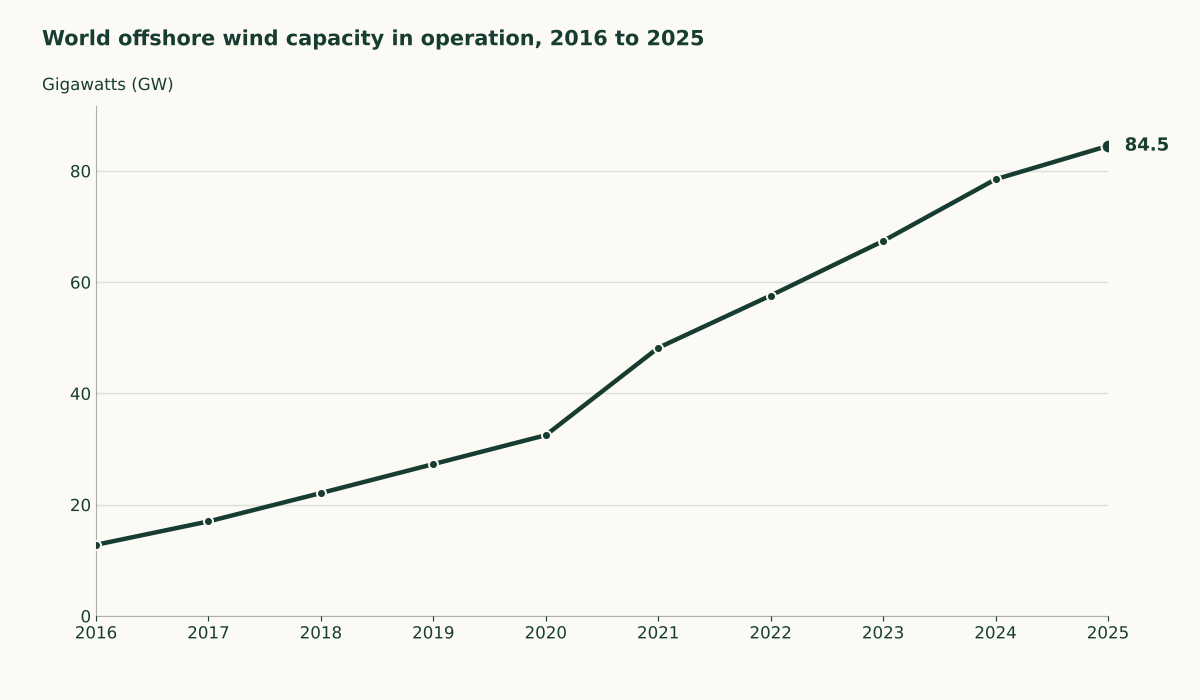
The Global Wind Energy Council reports a higher total, 92.5 gigawatts with 9.3 gigawatts added in 2025, because it counts every project feeding the grid. World Forum Offshore Wind counts a farm once all its turbines are installed and producing, so projects still being finished stay out and its totals run lower.
Which countries have the most offshore wind?
China leads the table below by a wide margin, with more offshore wind in operation than the next four countries combined.
| Country | Offshore wind in operation, end of 2025 (MW) |
|---|---|
| China | 42,315 |
| United Kingdom | 16,071 |
| Germany | 9,931 |
| Netherlands | 5,425 |
| Denmark | 2,687 |
| Taiwan | 2,655 |
| Belgium | 2,263 |
| France | 1,500 |
| United States | 174 |
Source: World Forum Offshore Wind and Westwood Global Energy Group, Global Offshore Wind Report 2025. Fully installed farms only. The US figure covers Block Island, South Fork Wind and the Coastal Virginia pilot.
The US row is small because Vineyard Wind 1 and Revolution Wind were still unfinished at the end of 2025, and Vineyard Wind’s last blade wasn’t secured to its 62nd turbine until March 13, 2026.
How much offshore wind does the US have?
The US has five fully operating offshore wind projects with a combined capacity of more than 1,600 megawatts, and three more under construction.
| Project | State | Size (MW) | Status | Date |
|---|---|---|---|---|
| Block Island | Rhode Island | 30 | Operating | 2016 |
| Coastal Virginia pilot | Virginia | 12 | Operating | 2021 |
| South Fork Wind | New York | 132 | Fully commissioned | March 14, 2024 |
| Vineyard Wind 1 | Massachusetts | 806 | Fully operating | October 29, 2026 |
| Revolution Wind | Rhode Island and Connecticut | 704 | Fully operating | October 2026 |
| Coastal Virginia Offshore Wind | Virginia | 2,600 | Under construction, 44 of 176 turbines installed, finish by end of 2027 | Q3 2026 |
| Empire Wind 1 | New York | 810 | Under construction, about 80% complete, first power mid-2027 | October 28, 2026 |
| Sunrise Wind | New York | 924 | Under construction, commercial operation in second half of 2027 | October 2026 |
Source: EIA, Today in Energy for Block Island and the Coastal Virginia pilot. NREL, Offshore Wind Market Report 2024 edition for South Fork Wind. WBUR and Electrek for Vineyard Wind 1. Offshore magazine for Revolution Wind. Utility Dive for Coastal Virginia. Maritime Executive for Empire Wind 1 and Sunrise Wind.
Revolution Wind sent its first power to the New England grid in March 2026. If you live in Rhode Island, it’s expected to meet 20% of your state’s electricity demand, and 5% of Connecticut’s. Vineyard Wind 1 produced 336,382 megawatt-hours in the third quarter of 2026, which the Boston Globe’s analysis equates to about 193,300 Massachusetts homes.
A farm’s rated size and what it delivers can stay apart for months. In May 2026 court filings, Vineyard Wind 1 said the farm was producing less than half its expected capacity, two months after its last blade went up.
Even with five farms running, offshore wind is a sliver of US wind power, which made 10.3% of US electricity in 2025 almost entirely from turbines on land.
What did the federal government do to US offshore wind in 2025 and 2026?
President Trump signed a memorandum on January 20, 2025 that paused new offshore wind leasing and permitting, and federal action against projects under construction followed through 2026.
| Date | Action |
|---|---|
| Jan 20, 2025 | Presidential memorandum withdraws federal waters from wind leasing and pauses permits |
| Apr 16, 2025 | Interior directs BOEM to halt work on Empire Wind, lifted May 19, 2025 |
| Aug 5, 2025 | Interior rescinds 3.5 million acres of wind energy areas and the lease sale schedule |
| Aug 22, 2025 | BOEM orders Revolution Wind to halt work, enjoined by a court Sept 22, 2025 |
| Dec 22, 2025 | BOEM suspends the leases of five projects under construction for 90 days |
| Jan 12 to Feb 2, 2026 | Courts grant preliminary injunctions to all five projects |
| Mar 23, 2026 | Interior and TotalEnergies agree to end TotalEnergies’ offshore wind leases |
| Apr 2026 | Interior lets the appeal deadline on the five injunctions pass |
| Aug 6, 2026 | RWE settles with Interior and gives up three lease areas |
| Sept 30, 2026 | Court dismisses the Empire Wind case after the suspension order expires |
Source: BOEM project pages for Empire Wind and Revolution Wind. Interior, December 22, 2025. Georgetown Climate Center for the January 2025 memorandum, the August 5 rescission and the injunction dates. Interior, TotalEnergies agreement. Electrek. RWE. gCaptain.
Interior gave national security as its reason for the December order and said the movement of blades and reflective towers creates radar interference that obscures real targets. Federal judges then granted the five projects injunctions between January 12 and February 2, 2026, and the court in the Empire Wind case dismissed it after the order lapsed, according to gCaptain.
Interior has also refunded lease payments to companies that agreed to drop their projects. TotalEnergies committed about $1 billion to US oil, gas and LNG in exchange for reimbursement of its lease costs, and RWE settled for $1.22 billion. In all, Interior has agreed to take back 12 lease areas for more than $3.9 billion, which ended ten planned projects totaling more than 16.5 gigawatts.
What does offshore wind cost?
A modeled new US offshore wind project cost about $125 per megawatt-hour in 2023 without subsidies, with a range from $75 to $149.
That figure comes from the 2024 market report of the National Renewable Energy Laboratory, now the National Laboratory of the Rockies, and averages consultancy estimates for a hypothetical commercial-scale project, not a real farm’s construction bill.
Real contracts give a second yardstick. If you get your power from Rhode Island Energy, 400 megawatts of it is contracted from Revolution Wind at roughly 9.8 cents per kilowatt-hour for 20 years. If you live anywhere in New England, Connecticut officials estimate the project will save the region about $500 million a year in wholesale power costs by 2028.
The global weighted-average cost of electricity from new offshore wind fell from $0.203 per kilowatt-hour in 2010 to $0.075 in 2023.
How does offshore wind compare with onshore wind?
Offshore wind runs at a higher capacity factor than onshore wind, and the table below shows the gap in both years. Capacity factor is the share of its rated power a turbine delivers over a year, and the efficiency of a wind turbine measures something different, how much of the wind’s energy the rotor captures.
| Global weighted average, new projects | Onshore wind | Offshore wind |
|---|---|---|
| Capacity factor, 2010 (%) | 27 | 38 |
| Capacity factor, 2023 (%) | 36 | 41 |
| Installed cost, 2010 ($ per kW) | 2,272 | 5,409 |
| Installed cost, 2023 ($ per kW) | 1,160 | 2,800 |
| Cost of electricity, 2010 ($ per kWh) | 0.111 | 0.203 |
| Cost of electricity, 2023 ($ per kWh) | 0.033 | 0.075 |
Source: IRENA, Renewable Power Generation Costs in 2023, executive summary.
EIA says offshore wind tends to run at a higher capacity factor than onshore wind but makes electricity that is generally more expensive. In IRENA’s figures, offshore power cost more than twice as much per kilowatt-hour in both years, even with the better capacity factor.
How much floating offshore wind is there?
The world’s first floating wind farm, Hywind Scotland, is a 30 megawatt pilot park that began producing electricity in October 2017. Equinor says its five turbines power about 35,000 UK homes.
Floating wind is still small. Less than 0.3 gigawatts is installed worldwide, and the 88-megawatt Hywind Tampen in Norway was the largest operational floating plant when it was fully commissioned in 2023.
The three US offshore wind farms due to finish in 2027
Three projects will set the US offshore wind total by the end of 2027: Coastal Virginia Offshore Wind, Empire Wind 1 and Sunrise Wind.
Dominion says Coastal Virginia is about 85% complete with 44 of its 176 turbines up and construction finishing by the end of 2027. Equinor now expects first power from Empire Wind 1 by mid-2027, later than planned because of delays in US-built support vessels. Newsday reported that Ørsted expects Sunrise Wind’s 924 megawatts to reach commercial operation in the second half of 2027.
Full output can trail the end of construction by months. Revolution Wind needed 1.5 months after construction finished to go fully online, and Vineyard Wind 1 needed 7.5 months.